

Why the Audience “Believes” the Entertainer
Theo Von or Shane Gillis could fart into a microphone in their next special and, still, compel the audience to laugh. Why? Not merely because they’re believable or famous, but because they observe Entertainment Constant Theory (ECT), aware of it or not, with well-serviced, established Character.
Understanding Entertainment Constant Theory
In Why the Entertainer Fails the Audience and Why Your Favorite Entertainment Works, I introduced ECT and its working formula, which is the following:
(S•N)C(TL)
The Entertainment Constant Theory (S•N)C(TL) Formula Explained
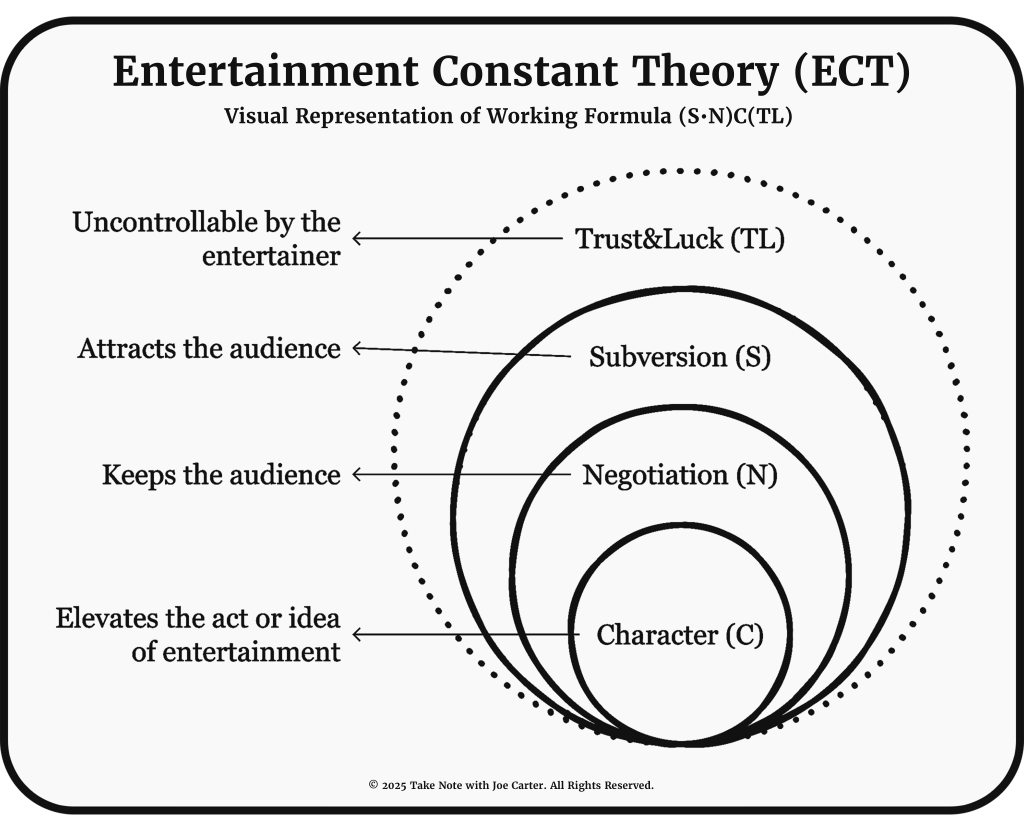
The entertainer or entertainment services Subversion (S) by Negotiation (N) with a consistent, suitable Character (C), or characters, in presentation to the audience. Trust&Luck (TL) cannot be influenced by the entertainer or any single member of the audience.
The Role of Character in Entertainment

When the audience says they believe in a character or characters, they are saying the character, or Character in the act or idea of entertainment, remained consistent and suitable for the Subversion and Negotiation on display by the entertainer. And how lucky for the entertainer–they will be paid.
Limits to Character, or “Character Development”
Character is influenceable by the entertainer, but like Trust&Luck, is as controllable as the time able to be spent with the audience. Thus the audience cannot be compelled by Character until it is presented to them over a duration of time.
A blogger, for instance, or a stand-up comedian, likewise, may service and present their ideas of entertainment, with consistent, suitable character, and raise their entertainment value, but is limited by the time, emotional bandwidth, and mental capacity of their readers or listeners. In a word, patience. Or Trust&Luck.
Hence Character (C) (see above) bridges the role of the entertainer (S•N, Subversion by Negotiation) and the phenomenon that is the audience for the entertainer or entertainment (TL, Trust&Luck).
Thus compelling entertainment curates itself by its Character remaining consistent and suitable, for as long as the audience is willing to stay–and remember them after, again, keeping the entertainer employed.
The Payoff for Well-Established Character
The entertainer with well-serviced, established Character both elevates their ideas of entertainment and bandages their loose ends, an amplifier and a safety net.
This multiplier effect can be powerful–allowing the entertainer to take material and present ideas of entertainment that might be mundane or even mediocre for another (inconsistent and unsuitable), yet is considered compelling entertainment by the audience when presented by the well-serviced, established Character.
The value of the entertainer relies on their continuous service to Subversion and Negotiation with consistent, suitable Character. And entertainment, likewise, whether film or music. Their Character starts to serve as a foundation to the other constants of entertainment by this theory (See a helpful diagram of Entertainment Constant Theory (ECT) in Why Your Favorite Entertainment Works.
Eventually, the entertainer can and must take risks that would sink others or even themselves were their Character not established. Why? Because audiences expect growth and evolution, or Subversion and Negotiation. Subversion, again, is at the root of all entertainment, as the handle is for the toilet. And a failure to Negotiate, the pipes, renders the toilet, Character, useless. The entertainer is, effectively, the plumber of the audience’s brains. They fix the mental drips caused by our brain’s constant calorie burn–that incessant questioning, “Why?”. And, more over, answer this question. “Because this is entertaining; this gets it.” The entertainment fixes a problem. The entertainer gets paid, and the audience, ideally, leave more patched up than when they came to the entertainer or entertainment–or than when it came to them. Just like working plumbing.
Avoiding Misuse of Character
The audience might mark the entertainer as courageous, someone who doubles-down or, on the other hand, suggest they get away with it only because they’re famous. These marks or labels should hold the same level of concern for the entertainer as Trust&Luck. Does the handle work, do the pipes function, and is the toilet clean?
Yet most emerging entertainers rely on Character early (with excessive dependence on Trust&Luck to boot), like withdrawing from a bank account before a deposit.
But well-serviced Character does not allow free rein either. Subversion and Negotiation must be serviced with that Character. Subversion cannot exist without some established Character.
Therefore, Character, and Negotiation by Subversion, creates a cyclical dynamic between these constants of entertainment, a chicken and egg situation for the entertainer (another weird metaphor). The entertainer is expected to take an egg (Character) and dress it (Subversion by Negotiation) into a chicken, or take a chicken (Character) and dress it (Subversion by Negotiation) into an egg, for the audience.
How Trust&Luck Influences Character
We’ve discussed how Character influences Subversion and Negotiation for the entertainer. Trust&Luck, the uncontrollable constant in entertainment, explains why the entertainer gets old, cancelled, or is not compelling to some, yet captivating for another.
The entertainer or entertainment may very well service Subversion by Negotiation with consistent, suitable Character for one audience—that audience trusts the entertainer to compel them—but that entertainer would draw boos from another. Isn’t that unlucky? Hence Trust and Luck is combined into a single variable.
To compel the audience, the entertainer must, beyond cease, answer the incessant question of “Why?” that is burning calories in everyone. If the audience loses trust in the entertainer or their entertainment to compel, they, like someone who’s lost trust in their toilet to flush, will seek a new plumber. (Nowadays, that’s swiping up—or left.)
Seinfeld, Carlin, Louis CK, Chappelle, Von, and Gillis’ career are extraordinary examples of how consistent, suitable Character emerges from dedicated service to Subversion by Negotiation. Other comedians prematurely rely on Character in their act or idea of entertainment, and worse, depend entirely on Trust&Luck. The likes of Gillis worked hammer and nail, toilet and plunger, to build acts that refresh comedy and culture. (which Gillis would say, “sounds pretty gay,” nevertheless).
Through consecutive effort, not artificial Character creation plaguing Hollywood entertainment and open mics around the world, the entertianer develops a presence that amplifies even their simplest bits, and protects when taking a stumble. This demonstrates ECT’s key insight: The material does not matter. Only the service to Subversion by Negotiation by the entertainer with a consistent, suitable Character, or characters—it cannot or should not be fabricated independently. And for the sake of the audience and the entertainer.
If you’re confused by all the plumber and toilet metaphors, see Why the Entertainer Fails the Audience, and subscribe to Take Note with Joe Carter as we wrap up this series with practical application of ECT for the entertainer, including calculating entertainment value. Also, share your thoughts with me—I enjoy what you share and will respond!

 Take Note with Joe Carter
Share Your Thoughts