

A Practical Guide for the Entertainer
For the entertainer in pursuit of compelling acts or ideas of entertainment, I will show how to calculate entertainment value.
This calculation signals the likelihood that an act or idea of entertainment will compel or engage the audience, which the entertainer, then, should reject, pursue, or prioritize.
ECT: How This Works and Why
Entertainment Constant Theory (ECT), in summary, claims the entertainer compels their client, the audience, by servicing entertainment constants. These constants include Subversion S, Negotiation N, and Character C.
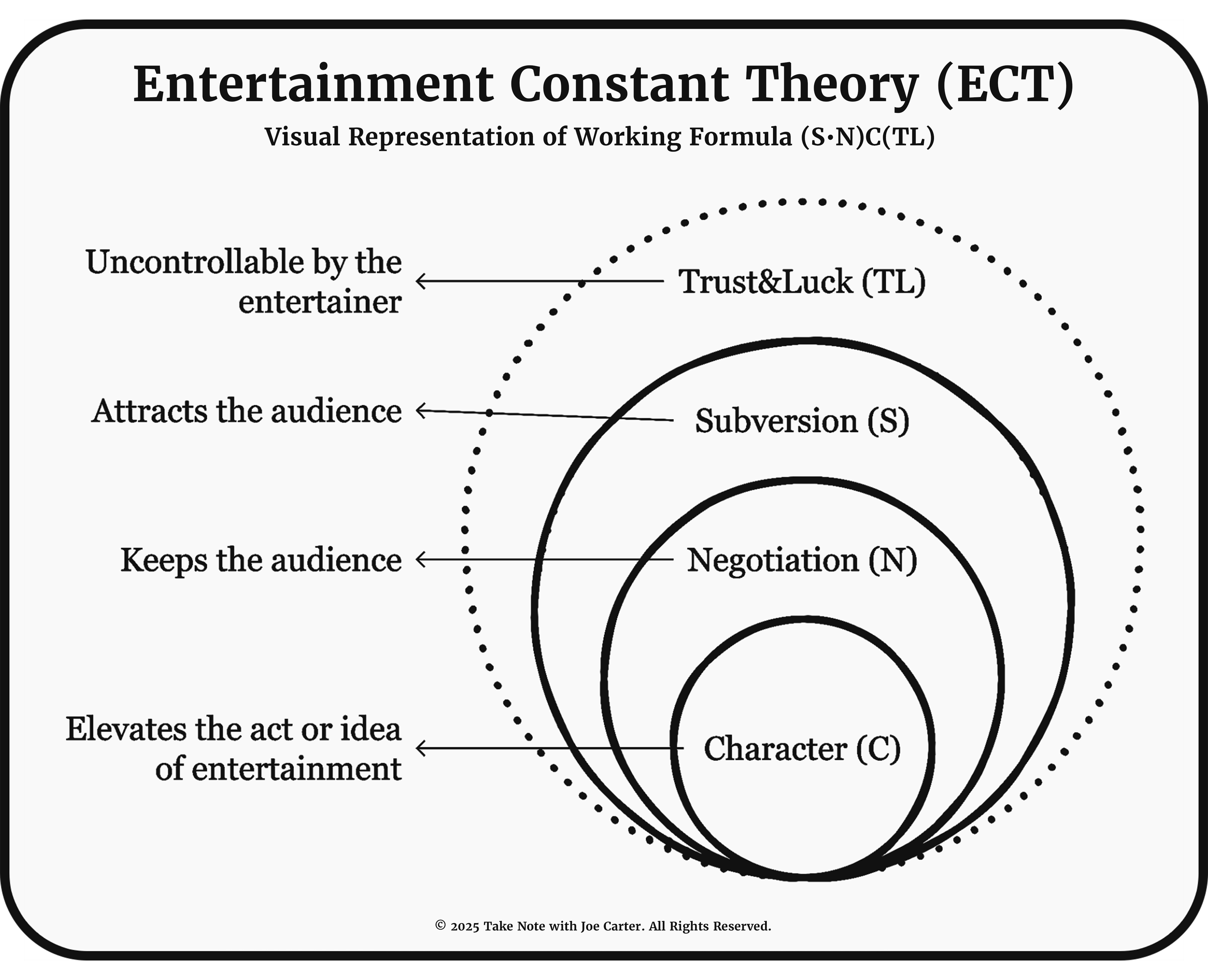
The content of the entertainment (what the entertainer refers to as “material”) does not matter, furthermore; only the proficiency or effort by the entertainer to service these constants for their act or idea of entertainment presented to and for the audience.
Removing The Incalculable
The uncontrollable entertainment constant, Trust&Luck TL, is not serviced so much as it influences the entertainer or entertainment, and the audience.
Despite tremendous efforts by the entertainer to service the entertainment constants, this variable explains why some of the audience is compelled, while some are not. The audience can lose trust merely by the look or age of the entertainer or entertainment. And isn’t that unlucky for the entertainer? (Hence I bundle Trust and Luck into a single variable.)
So when calculating your own ideas of entertainment, remove TL. Instead, focus on the entertainment constants within your sphere of influence: Subversion S, Negotiation N, and Character C, so (S•N)C. Those are most of the battle for the entertainer. Let’s start.
Take out those ideas with pen and paper.
The Subversion Filter (1-5 Scale)
Every act or idea of entertainment should start with evaluating Subversion. This is the handle—what the audience continuously reaches for and (rightfully) expects to work.1 The entertainer, as the plumber, can perfect everything—the pipes to the toilet model—but if the handle (Subversion S) doesn’t work, the entertainment fails its primary purpose.
Heads won’t turn—only away—and the audience will be quick to finding someone or something new to service them. (Another name for the entertainers of this caliber: preachers.)
Rate each idea of entertainment for its likely success in Subversion on a scale of 1-5:
(5) Highly subversive: Significant challenge or surprise to the audience
(4) Subversive: Unexpected turns, or turn
(3) Moderately subversive: Modest surprise
(2) Slightly unexpected: Minor twists, but familiar territory
(1) Entirely predictable: The audience knows what’s coming
Eliminate any idea scoring below 3 in Subversion.
Why? Subversion is at the root of all entertainment; the entertainer or entertainment that doesn’t service Subversion S does not and will not compel or engage the audience.
What subverts you sitting bored at your desk will likely subvert others, a personal tip. When developing acts or ideas of entertainment, pay attention to the ideas of entertainment you’ve recorded that when later read make you lean, feel a surge of interest, or laugh. These reactions signal a high value in Subversion, thus a chance it is an act or idea of entertainment high in entertainment value.
More Subversion Is Better…?
Why not be more scrupulous, and remove ideas rated 3, even 4? Because lower-rated ideas in Subversion S can, still, be elevated, once later multiplied by Character C and Negotiation N. These are calculated respectively.
The Character Assessment (1-3 Scale)
Once ideas rated 1-2 in Subversion are eliminated, the entertainer should assess and rate the remaining for their values in Character.
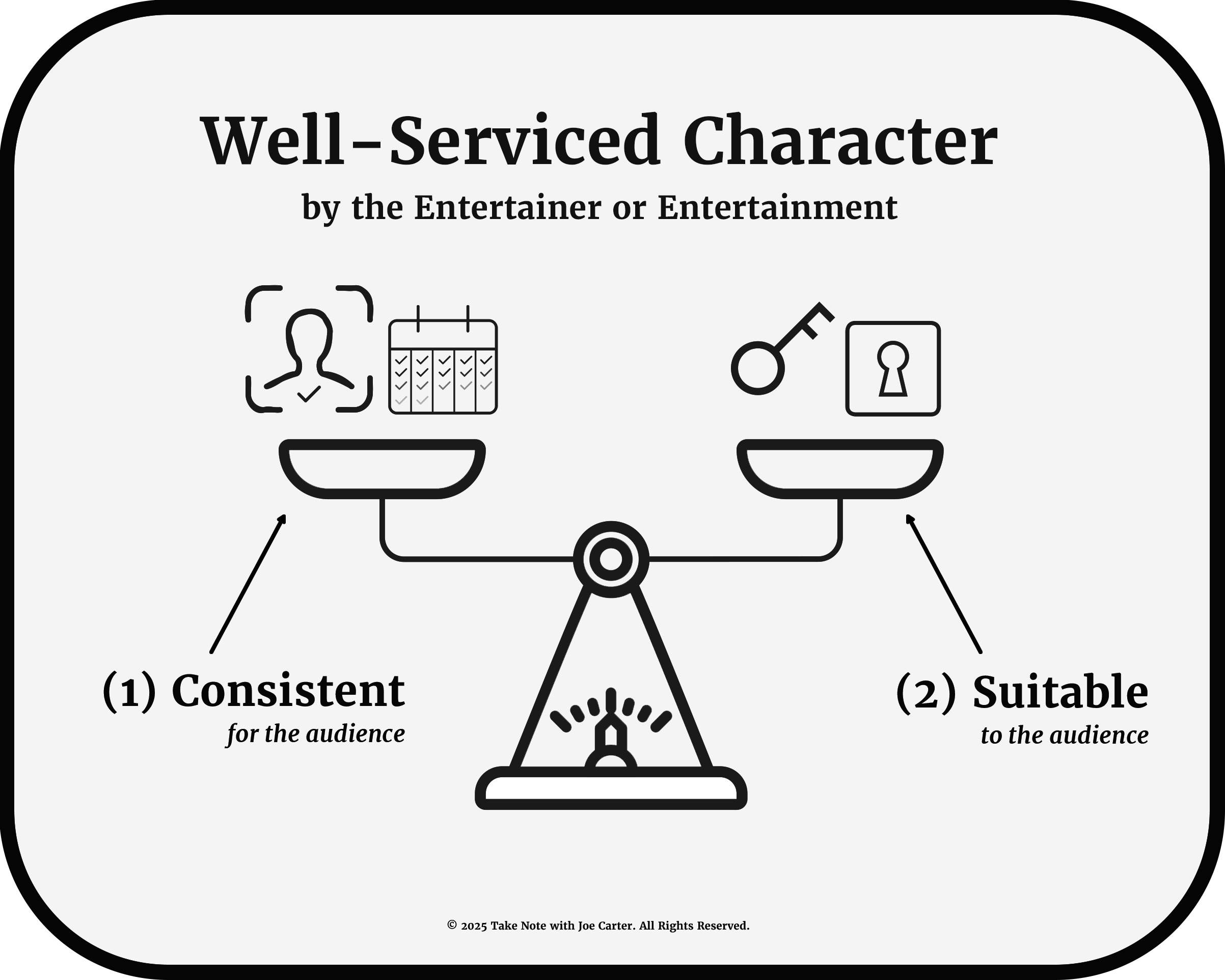
Whether evaluating a personal persona, a sketch, or fictional characters in a narrative, the principle in Entertainment Constant Theory remains the same. Well-serviced Character in all of compelling, engaging entertainment is (1) consistent, and (2) suitable.
Rate these ideas of entertainment for consistent, suitable Character on a scale of 1-3:
(3) Perfectly aligned: Naturally reinforces or expands on the presented Subversion or established Character
(2) Neutral: Neither enhances nor contradicts the presented Subversion or established Character
(1) Misaligned: Contradicts or undermines the presented Subversion or established Character
Eliminate any idea scoring 1 in Character assessment.
Why? Character isn’t the foundation of entertainment, but total Character misalignment weakens the service by the entertainer for the audience.
Therefore, first, the audience needs some thread of consistency to follow. Second, a sense of suitability to view or feel the act or idea of entertainment would be hard pressed or less effective should it be presented by another. These ingredients, consistency and suitability, are the pepper and salt of well-serviced Character C in entertainment. (See the diagram above, and read more in How Character Shapes Compelling Entertainment.)
The Negotiation Evaluation (1-5 Scale)
Finally, evaluate and rate each idea for its likelihood of success in Negotiation.
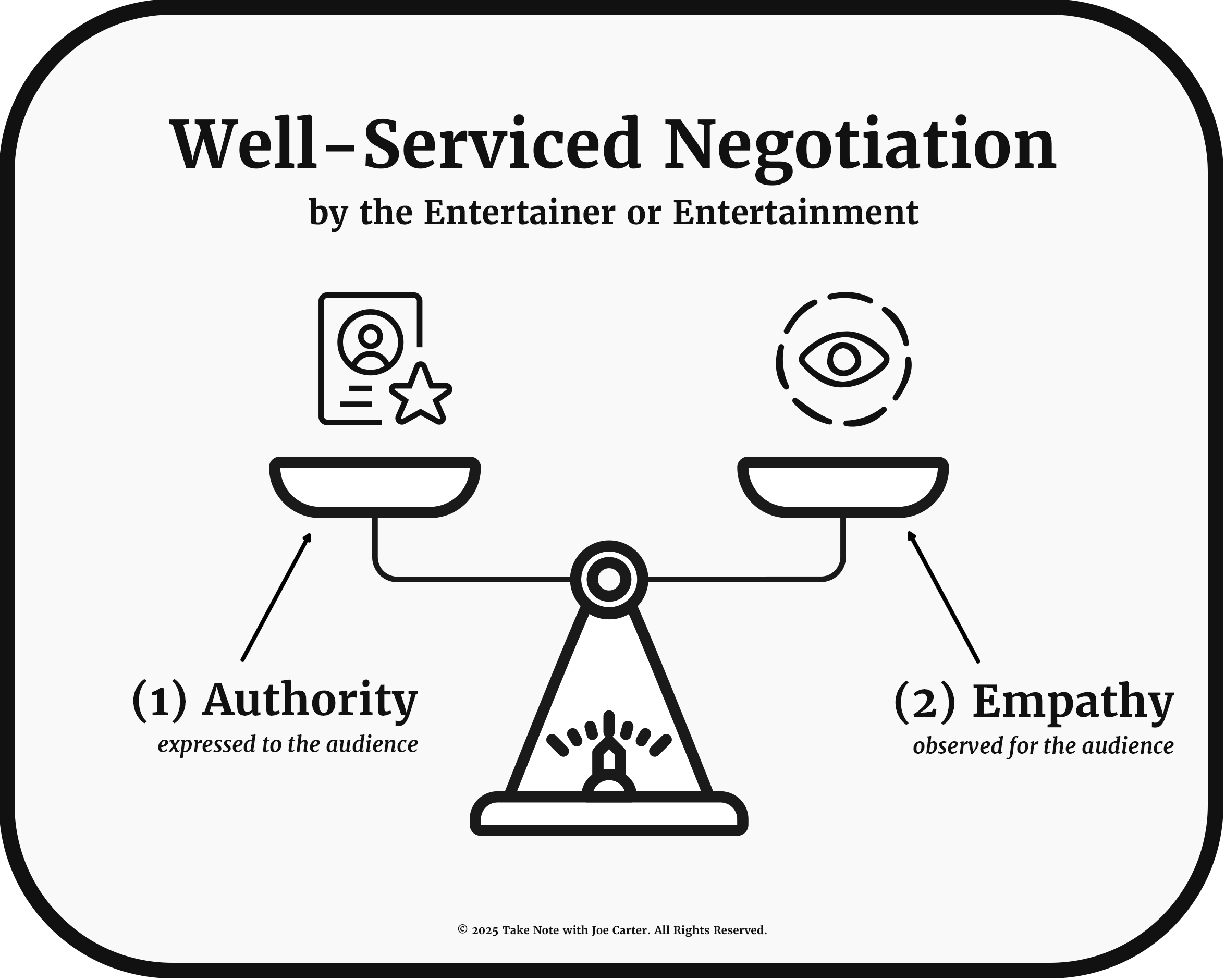
As in the businessman, so in the entertainer—not every negotiation will go their way. But there are two ingredients the entertainer can and regularly uses to service Negotiation N for the audience, as there is for Character C. These ingredients are (1) authority, and (2) empathy—water and vinegar.
Authority expressed by the entertainer, first, is demonstrating to the audience knowledge or credibility related to the act or idea of entertainment, what should be Subversion S on display.
Empathy, on the other hand, is expressed or merely observed, the entertainer viewing and addressing the perspective of the audience. This includes likely confusion or objection to the act or idea of entertainment.
Rate each idea of entertainment for its likely success in Negotiation on a scale of 1-5:
(1) Likely Impossible: The entertainer or entertainment lacks authority and empathy to and for the audience
(2) Likely Difficult: Significant deficiencies in either authority or empathy to and for the audience
(3) Moderately negotiable: Adequate amount of authority and empathy to and for the audience
(4) Likely negotiable: Strong capacity in both authority and empathy to and for the audience
(5) Highly negotiable: Immense in both authority and empathy to and for the audience
Eliminate any idea scoring below 3 in Negotiation.
If the entertainer or entertainment lacks authority for the act or idea of entertainment, the audience will sniff it out in seconds. And if the entertainer expresses or observes empathy that’s on another planet from what the audience is actually feeling, the entertainer should, too, prepare for backlash. Or worse for the entertainer, disengagement.
Therefore, the audience desires competency, but not at the cost of connection. They want effective, structured pipes (authority), that connect (empathy) to the toilet (Character C). Without this, the entertainer is a waste of time (and space) for the audience, bored desperate, and needing relief.
Final Calculation
Once the entertainer determines the constant values of each idea of entertainment through this series of rounds, the following is the final calculation.
(1) Multiply the Character C rating for each idea of entertainment by the Negotiation N rating
(2) This provides a score ranging from 6-15
With this number, you have calculated entertainment value. Value for the entertainer, value to the audience; value for the audience, value to the entertainer.
And for the entertainer, refer to the following.
- Prioritize ideas scoring 9 or higher
- Pursue ideas scoring 6 or higher
- Toss ideas scoring 5 or below
The entertainer should pursue ideas equating to or beyond 6—and especially ideas scoring 9 or above.
Aren’t Bigger Numbers Better…?
We do not calculate Subversion in the final calculation.
The entertainer already purges ideas rated below 3 in Subversion S. And multiplying Character C by Negotiation N alone helps to keep the sum smaller, yet still effective at indicating value of the idea of entertainment for the entertainer.
More over, the entertainer should not and can’t include Trust&Luck TL in their calculation; shaving off Subversion S only halves the result. Still helpful. Finally, what’s this calculated number to the compelled, engaged audience?
Example Calculations of Entertainment Value
The following is how someone might evaluate the entertainment value of their ideas of entertainment, and decide on which are more or less likely to succeed in compelling or engaging the audience.
(1) Joke about my weird experience at the DMV yesterday
| Entertainment Constant | Rating | Why |
|---|---|---|
| Subversion S | 2/5 | DMV jokes are common territory with predictable frustrations |
Decision: REJECT (S = 2)
Anything less than 3 in Subversion S isn’t worth developing. This handle is broken.
(2) Joke about why I secretly prefer bad hotels to luxury ones
| Entertainment Constant | Rating | Why |
|---|---|---|
| Subversion S | 4/5 | Counters expectations; most celebrate luxury |
| Character C | 3/3 | Reveals authentic perspective that strengthens unique worldview |
| Negotiation N | 4/5 | The entertainer can demonstrate knowledge of both (authority) while acknowledging audience’s likely preference for luxury (empathy) |
Decision: PRIORITIZE (C×N = 12)
This idea of entertainment shows a high potential to connect with the audience. The handle works, the pipes function, and the toilet looks just as it should.
(3) Joke about my conspiracy theory about neighborhood cats
| Entertainment Constant | Rating | Why |
|---|---|---|
| Subversion S | 3/5 | Moderately unexpected angle on a familiar subject |
| Character C | 2/3 | Neither contradicts nor particularly enhances established persona |
| Negotiation N | 3/5 | Might have authority, but may struggle with empathy on this unusual topic |
Decision: PURSUE (C×N = 6)
This premise might work for the entertainer with careful service to Negotiation. The handle is decent, the pipes need work, and the toilet is presentable enough in that it’s not missing a seat.
(4) Song about my conspiracy theory about neighborhood cats
| Entertainment Constant | Rating | Why |
|---|---|---|
| Subversion S | 3/5 | Moderately unexpected angle on a familiar subject |
| Character C | 3/3 | Guitar wrapped around their neck: consistent, and suitable as they are proficient at playing |
| Negotiation N | 4/5 | This entertainer is proficient at playing guitar, and plans to implement a dash of empathy or observing the audience within the lyrics |
Decision: PRIORITIZE (C×N = 12)
This idea of entertainment is better as a song than a joke for the entertainer. The handle remains decent, the toilet is more presentable, and the pipes can be made strong.
Conclusion: From Theory to Practice
This three-constant approach creates a framework for evaluation by the entertainer for what is their role. It doesn’t replace creative intuition—it enhances it by bringing objectivity to what’s often an emotional, seemingly ethereal process.
Entertainment is not random or mysterious. It’s a craft with identifiable components that can be deliberately serviced by the entertainer. By focusing on the three constants the entertainer can control, while respecting that Trust&Luck TL and aspects of Character remain beyond any direct influence, it beats depending on Trust&Luck to propel you or the entertainer.
This concludes my four-part series on Entertainment Constant Theory. I’d love to hear how you’ve applied these principles to your own creative work. Share your experiences in the comments below, or drop me a line.
- See our plumbing metaphor for working entertainment introduced in Why the Entertainer Fails the Audience. ↩︎

 Take Note with Joe Carter
Share Your Thoughts