On Writing Jokes (or Anything Else)
The following will detail how I write a joke, but it should help you in writing just about anything. Unless you’re using ChatGPT like everyone else, apparently, which nearly provided me a panic attack learning about this weekend.1
First, I need to explain what I call non-linear note-taking, or if you prefer non-linear writing.
Non-Linear Note-taking
Non-Linear note-taking is the act of jotting your ideas down whenever they strike, organizing them at a later date, then, usually at an even later date, creating anything — songs, screenplays, books, jokes, articles — from these sorted ideas. It’s a concept that baffled one of my film professors. From then on, I knew there was something to it. 2 How a writer sits at their desk and works without reference material is beyond me. (Talking to you, Aaron “Always In Writer’s Block” Sorkin.)
It becomes not much unlike reading a social media wall — but only about you. What could be better?3
While David Allen calls this methodology Getting Things Done, I now prefer to call it a self-media lifestyle. Rather than using social media, a self-media lifestyle is ultimately more interesting, helpful, and becomes all the same addicting of an experience.
In addition, it effectively destroys writer’s block because you sit down with new material virtually every day.
But I’m getting ahead of myself. Let’s learn how to write a joke, or anything else.
How To Write a Joke (or Anything Else)
My writing process is as follows.
(1) Organize the Ideas
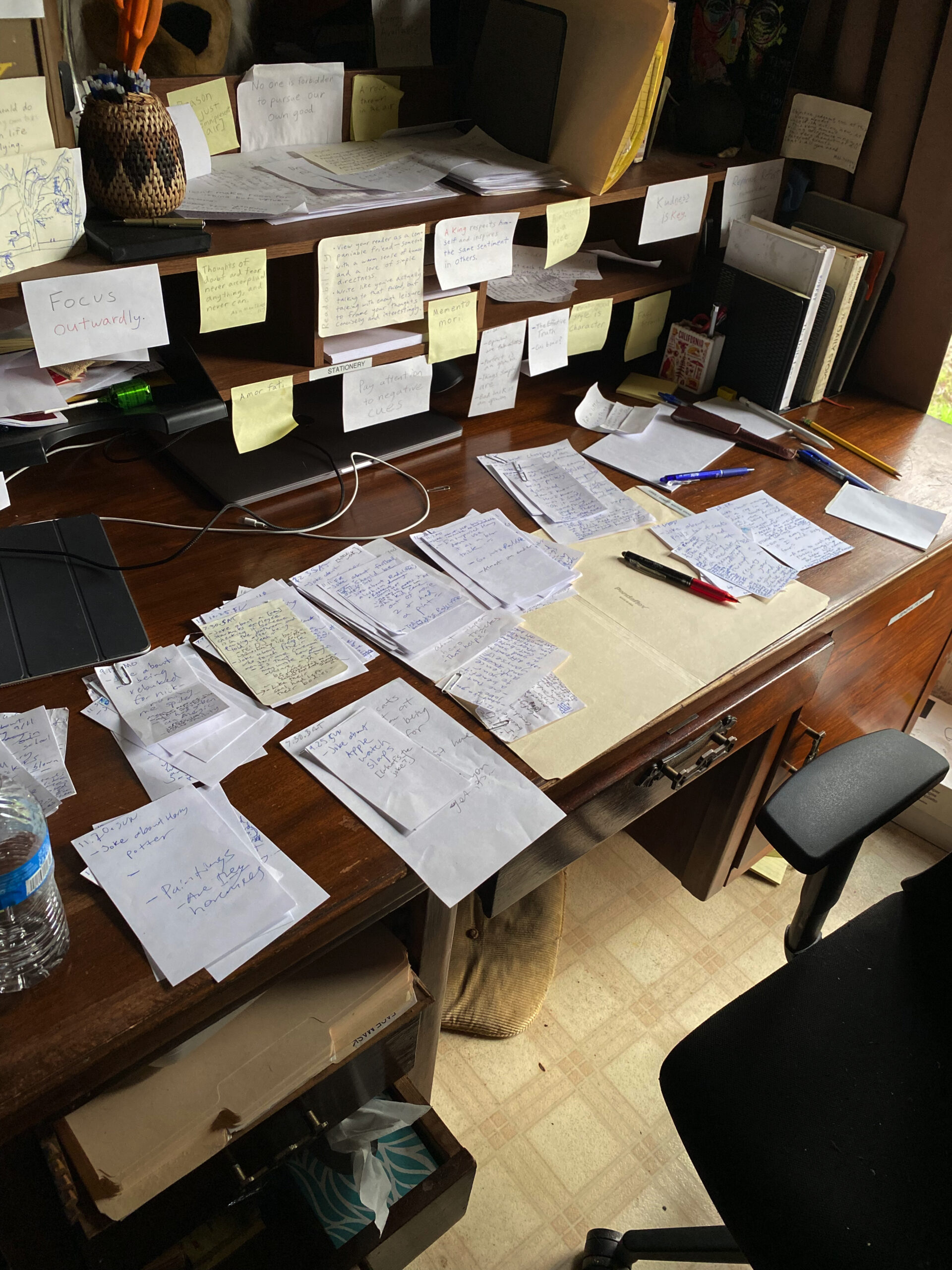
I take out my folder of ideas, in this case jokes, and sort them out arbitrarily with paperclips (see image above).
Rating joke ideas, as I’ve found with song ideas, is a poor idea. A joke’s either funny (and thereby useful to your writing) or not funny; a number or star system shouldn’t influence. The most I’ll add is an explanation point if I know there’s something definitely there, something I’m excited to work with. But occasionally even these I’ll toss.
I’ll archive the rest, or choose to put them in a “Bad Joke Ideas” folder. This helps guide you with what you shouldn’t write, and find what you should. Again, the same goes with developing anything else, for instance marketing materials.
(2) Perform the Joke
Once organized, I’ll take a pile I like, and when a joke makes me laugh, I’ll take out my iPad or iPhone to record myself delivering a rough account of the joke. For the moment, it can sound pretty dreadful, like a guitarist not used to singing at the same time as playing.
My secret to this, with every joke I take a note of, is using a consistent template: “Joke about blank.” If I can fit it in that template, I know a joke written even a year ago I can still recount. Especially when there’s added bullet points to supplement the material or give context.4
Back to the recording: There is an immense benefit to recording a first take. I’ve found there’s only so many times I can tell a joke verbally before the joke gets stale, no different from rehearsing a song too many times in a single day. Therefore, to capture that first-read acts as a safety net when you’re half-way through writing. Occasionally, you don’t need it, but you’re always glad to have it.
(3) Write the Joke
Which leads to the writing. I’ll take out an A4 sized yellow sketch-pad (a la Seinfeld) and carefully write out the joke as though I were developing a song. More over, Seinfeld writes similarly if you check out his book, something that delighted me.
For instance, I’ll include spaces for where I believe there will be a laugh, or at least create a clear pacing. I anticipate this helping immensely when I practice memorizing these jokes. (Yes, I still have not performed yet.)
(4) Finish Up
Finally, I’ll attach the original note that birthed the joke to the written draft, fold them together, and put them in a different folder, officially titled “Jokes / Comedy Writing Drafts” (yes, a bit of a mouth-full). As for that first-take recording mentioned in (2), I’ll toss it. Usually filled with f-bombs and awkwardness, if the joke doesn’t land after this process, the recording isn’t going to help.
Instead, I’ll record again in the revision phase — which is worth having another conversation.
Conclusion
I’ll reference Seinfeld a final time: Let the mind run wild on a first draft, then take care of it another day. It’s hard enough to sit and write for an hour. And from Ryan Holiday on the Daily Stoic podcast: You can’t edit what isn’t there.
But with the system I detailed above, you’ll get yourself something to work with and with relatively little pain. Repeat it a few, several hundred times to become Jerry Seinfeld, or whoever’s other shoes (including Aaron Sorkin’s). Good luck!
- Jordan Peterson speaking over spooky BROLL. I wrote a joke, though, to feel better: The video depicts a brain hooked up to XLR cables. My college roommate could make one of those. But fear sells best. ↩
- Getting Things Done by David Allen, which I read many years later, validated this concept. ↩
- Learn more about narcissism in Robert Greene’s The Laws of Human Nature. More than recommended, knowing how humans actually operate is critical to your survival. ↩
- I’ve been a long-time advocate for bullet journaling. A great system for this is by Ryder Carroll, and is the one I use today. At 16 through 24 I used a different system, one I might explain another day. ↩

 Take Note with Joe Carter
Share Your Thoughts