Discoveries in Self-Development
On Daily Writing
“Groups are infectious,” writes Robert Greene. A pen and paper is an invaluable tool for separating yourself from the group and determining what you alone believe.
But pen, paper, and yourself alone can be a limitation.
Without coupling writing with the learning of wisdom, you’ll experience the definition of insanity. This is where I find fault in “The Artist’s Way” and it’s widely praised morning pages technique.1 Three pages every morning can only help so much.
Therefore, I’ve read from a text each morning since 2020 before morning pages, currently the Daily Stoic by Ryan Holiday and the Daily Laws by again Robert Greene; sometimes writing loosely what I read, sometimes entirely, and other times not at all.
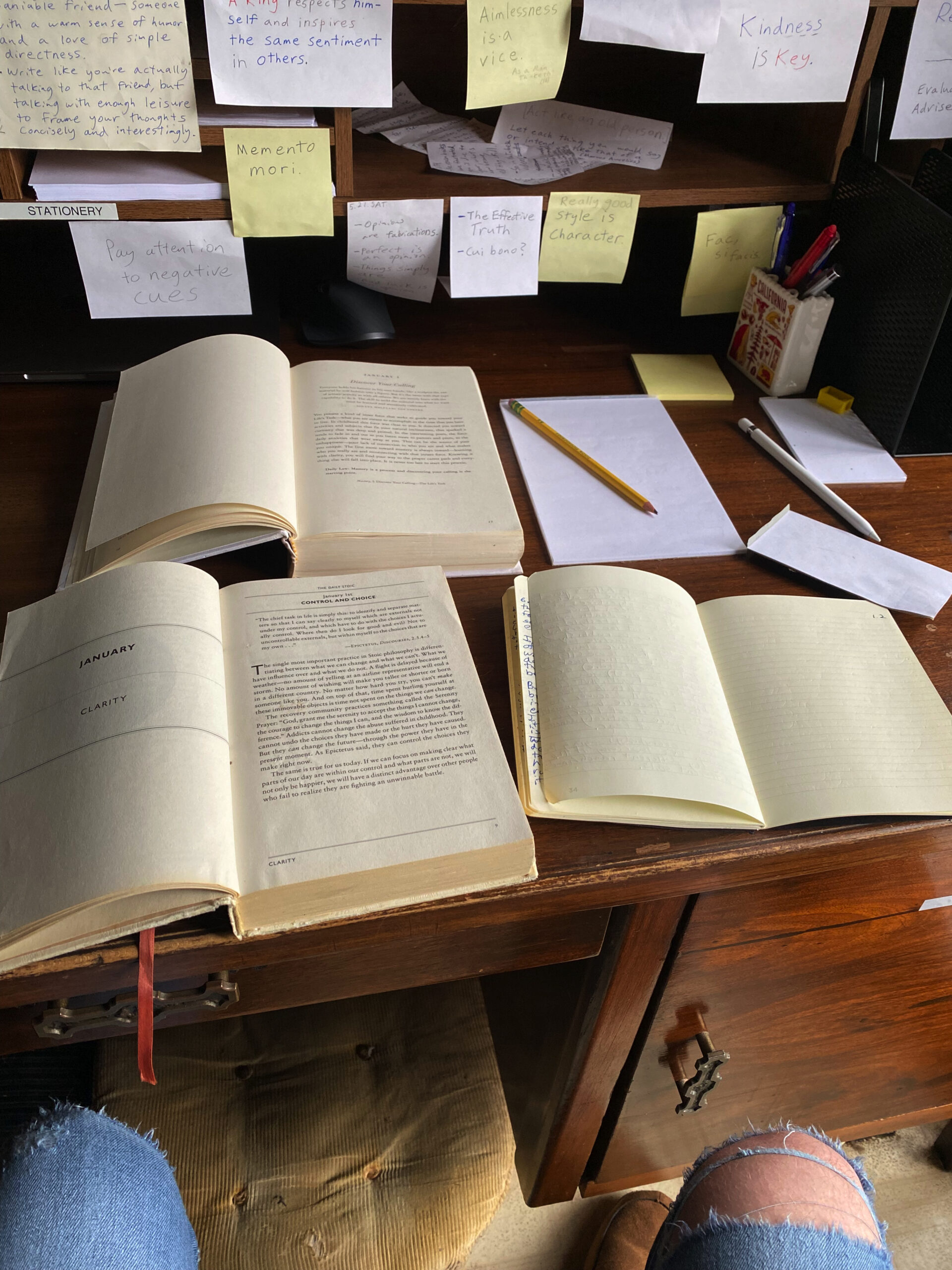

The feeling a journal writer experiences going around in circles within their head alone… Well, I wouldn’t wish it on anyone. And it’s incredible how wisdom read can be relevant at any point in your life.2 Staying up late with friends, for example, has been an issue for myself since the holidays. This morning: How and why to say no to the things that don’t matter (Holiday), and, in addition, how to find your voice (Greene).
It’s used to death, but Mark Twain writes:
“The man who does not read has no advantage over the man who cannot read.”
So the man who does not read or write has no advantage over the man who cannot read or write.
Journaling, eventually in one’s life, should be used to work out problems, not add more heat to the flame. There’s a development stage, admittedly, but eventually a habit of journaling and study becomes a proficiency, like can any other skill.
A New View on Productivity
Speaking of proficiency, I’ve read the first two chapters of Free To Focus by Michael Hyatt. A game-changer to have learned is Michael Hyatt’s alternative productivity matrix. I say alternative because there are many, including the Eisenhower Matrix and the Stephen R. Covey’s Time Management matrix. The two are similar, but I’ll explain Covey’s briefly to compare with Hyatt’s.
The Time Management Matrix
I started using the GTD methodology by David Allen in May 2021. After experimenting with another system by Business Made Simple, I stuck with GTD.3 But picking what I should do next became increasingly difficult once projects exploded in number.
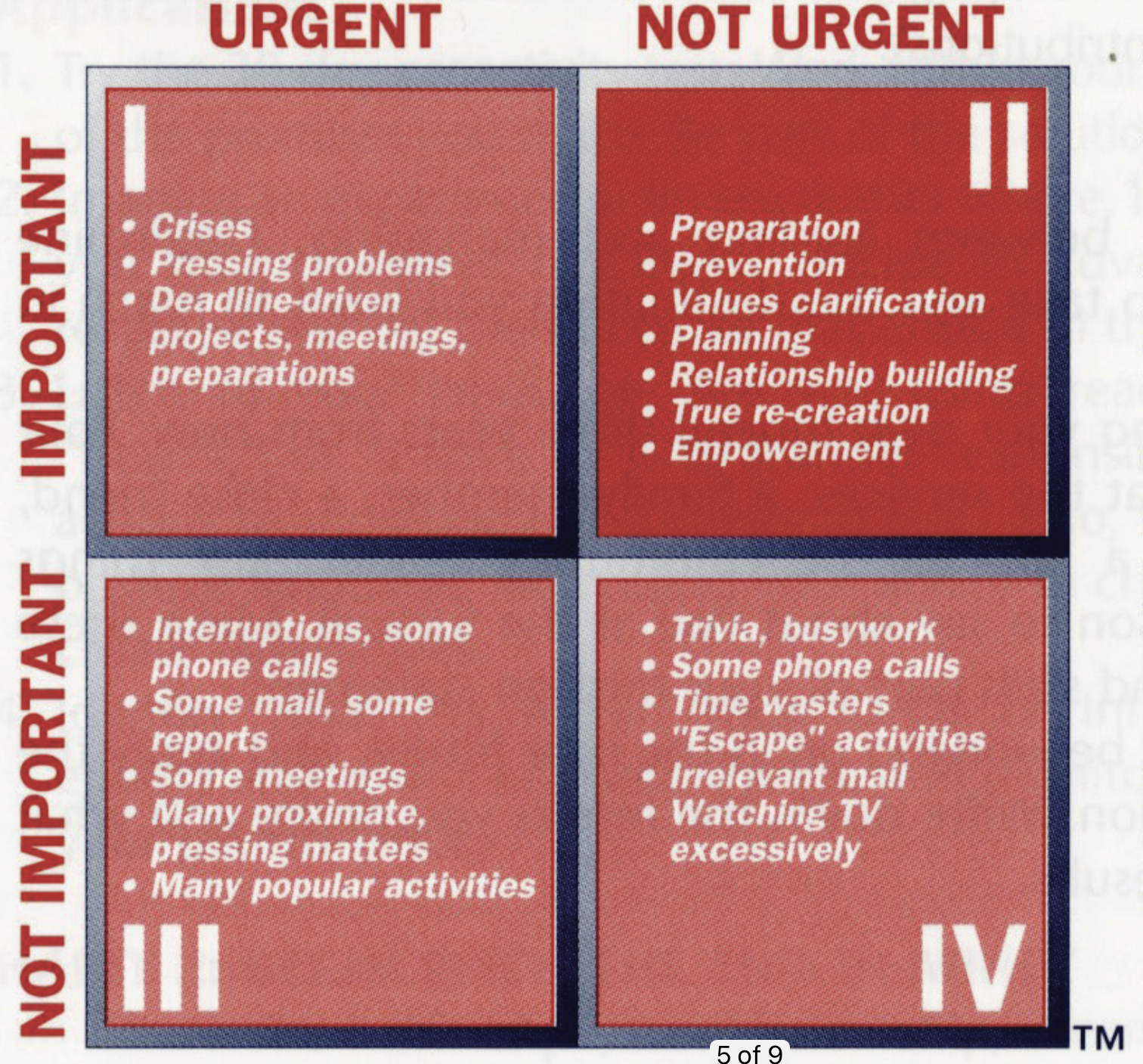
So I discovered Covey’s Time Management Matrix in reading the Seven Habits of Highly Effective People. To sum up, it balances the Urgent and Important.
Referencing the image above, one should as much as possible focus on the Not Urgent but Important, Quadrant II, because that’s where our “world-changing” tasks lie. These tasks don’t tend to be urgent, to grab at our attention, hence why so many procrastinate on completing what they actually care about.
Many people, business owners in particular, believe that everything is Urgent and Important, Quadrant I, leading to a hectic lifestyle. Others choose what’s Urgent but not Important, Quadrant III, so complete what many call “busy work.” Finally, the Not Urgent and Not Important doesn’t need explaining — yet so many people find themselves there, Quadrant IV, spending most of their lives.
Hyatt shares a different matrix, or “compass,” balancing Passion and Proficiency.
Hyatt’s Freedom Compass
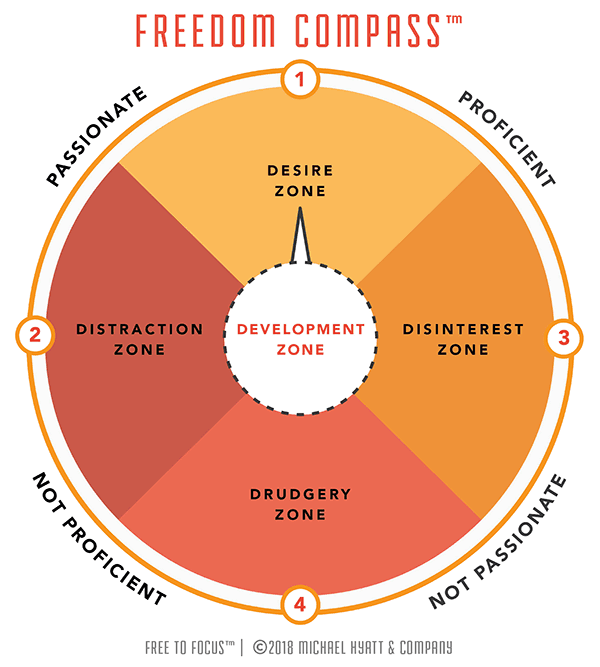
In deeming his matrix a compass, we want to focus as much as possible completing tasks that we both are passionate and proficient — true north — or at least as much as possible. I’m a well-experienced video editor, for example, though my passion for the craft is thin by comparison to others. That’s OK — it doesn’t mean I shouldn’t edit or even create a company to help other video editors (so I’ve mentioned), but delegating the work or somehow minimizing it wouldn’t be a bad idea.
As we should focus on our Important but Not Urgent tasks and projects, similarly, true north is your unique contribution, your most significant contribution you can give to the community. And feeling a contribution to others, Alfred Adler writes, again, is happiness.
In summary, Hyatt’s method does a wonderful job to single out Quadrant II tasks and projects, to determine what you should really be focusing your time on.
Regarding last week, there’s been around five projects on my mind as of late — all Quadrant II. And running them through this “compass,” I’ll save the results for sharing this Friday.
What I will say is becoming a performer may not be so “selfish” as I said; and the other projects seem far less life-shaking; so long as I aim for north, again. Besides, now thinking about it, Important and Urgent are words that tend to generate stress no matter the context.
I’m glad to have given Free to Focus a chance; it’s already proven to be an “important” compliment to what I’ve learned so far.
See you on Friday.
- It’s recommended also to have “Artist’s Dates,” which you spend two hours each week creating art. Admittedly, I never fully committed. I’m skeptical still, though, as I was utterly confused at life when having read the Artist’s Way. ↩
- Likely why quotes are popular to the point of commercialization on the internet. ↩
- In fact, using GTD, I stored away the productivity materials by Business Made Simple, effectively swallowing its system. ↩

 Take Note with Joe Carter
Share Your Thoughts